Case – Fast Aerodynamic Simulation for APS Product Scoping
Seasight Solutions

External simulations slowed every new opportunity
As wind turbine blades continue to increase in size, lifting solutions must scale with them. Seasight Solutions needed a faster and more cost-efficient way to assess whether its Autonomous Positioning System, APS, could support new and larger wind blade applications.
Previously, each new scoping request depended on external consultants using high-resolution simulation tools. While technically advanced, the tools were time-consuming to set up, costly to run, and produced more data than needed for early-stage product estimation.
As a result, customer requests for larger blade applications could take 3 to 6 weeks to answer. Seasight Solutions also had limited control over its own scoping and quotation process.
A simpler model built around the real decision need
We reviewed the scoping process and identified that high-resolution simulation was more than Seasight Solutions needed for quotation work.
Instead, we proposed a faster, purpose-built process supported by a 1 degree of freedom simulation model of the APS product and lifting setup.
The Python-based tool was integrated directly into the engineering team’s workflow and enabled engineers to quickly assess APS performance across different wind turbine blade scenarios.
The tool can:
Seasight Solutions was closely involved throughout development. Feedback from demo versions was continuously built into the final functions, ensuring the tool matched the team’s practical engineering and quotation needs.
Seasight Solutions
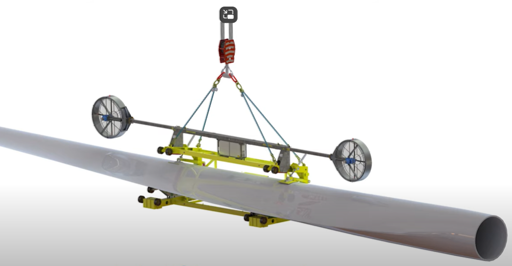
Seasight Solutions produces lifting accessories for wind turbine blade installation.
Its Autonomous Positioning System, APS, keeps blades stable and controlled during lifting, supporting safer and more efficient installation of increasingly large blades.
From weeks of waiting to answers in 10 minutes
The new simulation tool gave Seasight Solutions direct control of APS product scoping and made the process almost cost-free. Engineers can now assess new blade scenarios independently, without waiting for external consultants or paying for expensive external software.
Scoping time has been reduced from 3 to 6 weeks to around 10 minutes — a reduction of approximately 99 percent. The financial impact was equally clear. Seasight Solutions now spends 0 euros on consultants for this part of the process, compared with previous costs of around 30,000 euros per scope.
With a purpose-built engineering tool, Seasight Solutions can now respond faster to customer requests for larger wind turbine blade lifting applications. The solution strengthens internal control, reduces quotation costs, and enables faster early-stage decision-making as wind turbine blades continue to grow in size.
Are you interested in learning more about DIS/CREADIS?
Enter your information in the form and we will contact you shortly.